第3章 · 原课件与完整中文翻译
上方为英文原页,下方为对应的完整中文翻译,标题、正文、图内文字和公式按原页顺序排列。
页号按PDF顺序。原课件的历史日期、学期、课堂安排和研究结论按原文保留;相关概念与适用条件见教程正文。符号、代码、作者姓名及便于检索的专有名称保留原文。
Lecture 03 · 44页
Lecture 03 · PDF p1
Lecture 03 · PDF p2
Lecture 03 · PDF p3
Lecture 03 · PDF p4
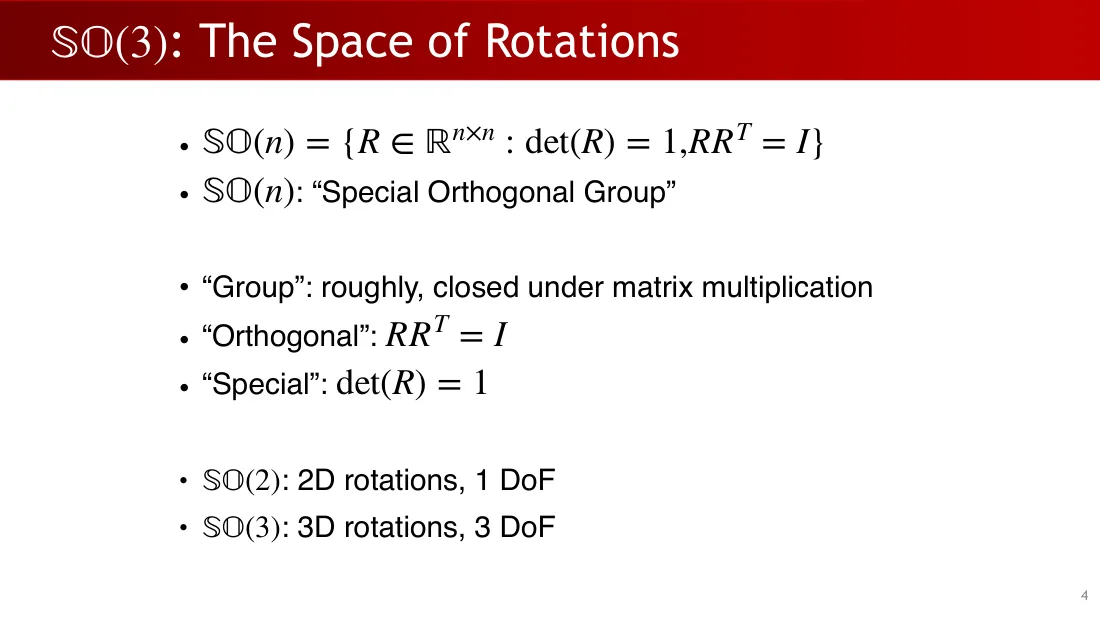
Lecture 03 · PDF p5
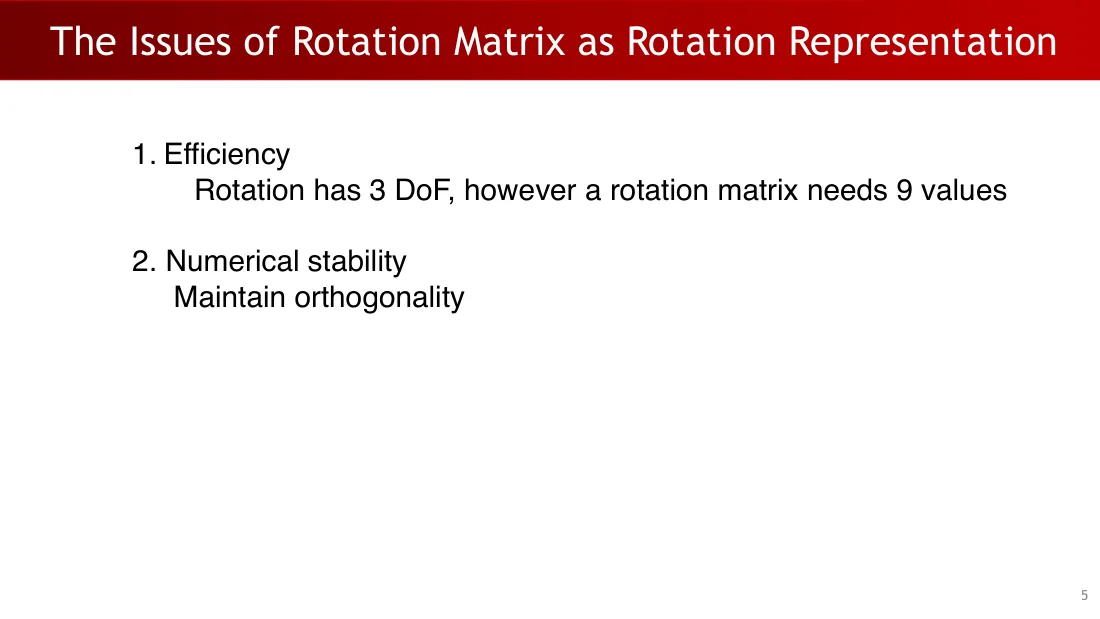
Lecture 03 · PDF p6
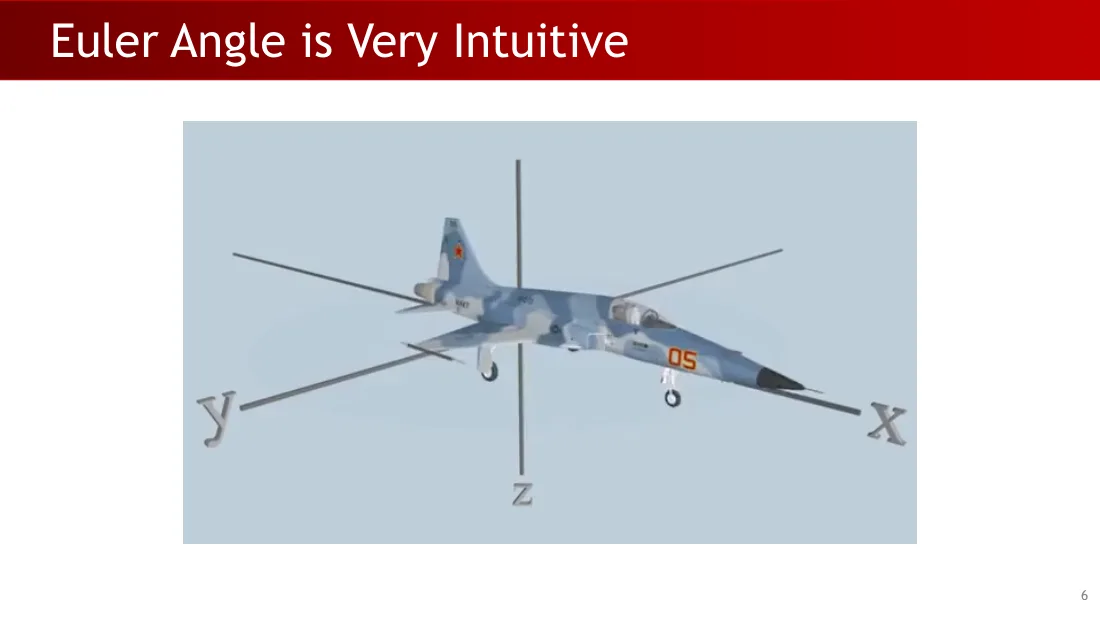
Lecture 03 · PDF p7
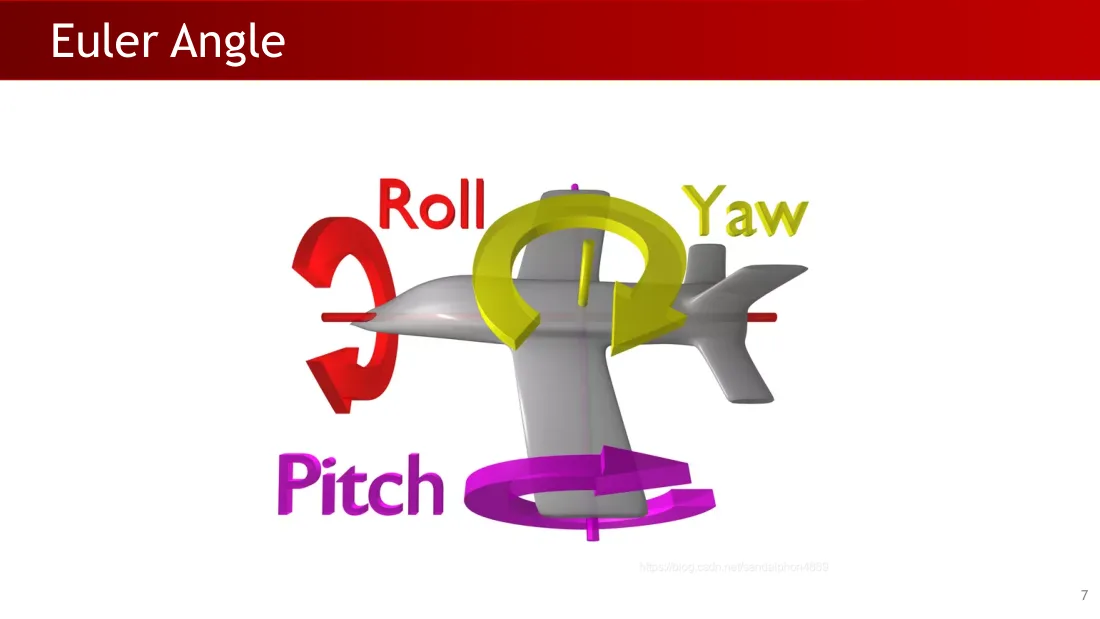
Lecture 03 · PDF p8
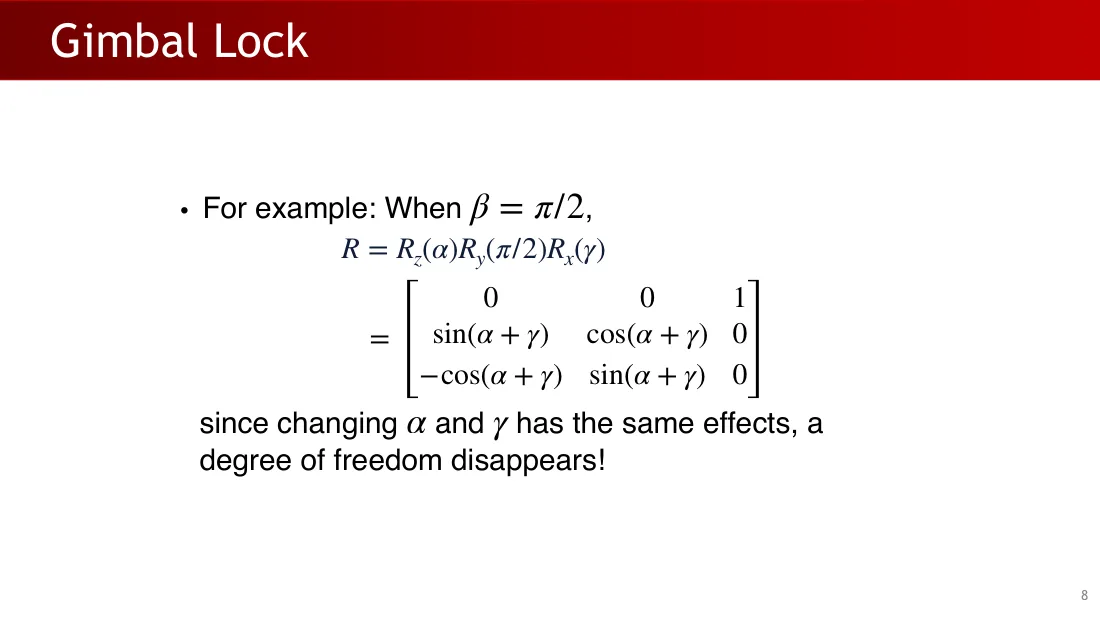
- 例如,当 \(\beta = \frac{\pi}{2}\) 时,
\[R = R_z(\alpha )R_y(\frac{\pi}{2})R_x(\gamma )\]
\[= \begin{bmatrix}0 & 0 & 1 \\ \sin(\alpha +\gamma ) & \cos(\alpha +\gamma ) & 0 \\ -\cos(\alpha +\gamma ) & \sin(\alpha +\gamma ) & 0\end{bmatrix}\]
因为改变 \(\alpha\) 和 \(\gamma\) 会产生相同的效果,所以一个自由度消失了!
Lecture 03 · PDF p9
Lecture 03 · PDF p10
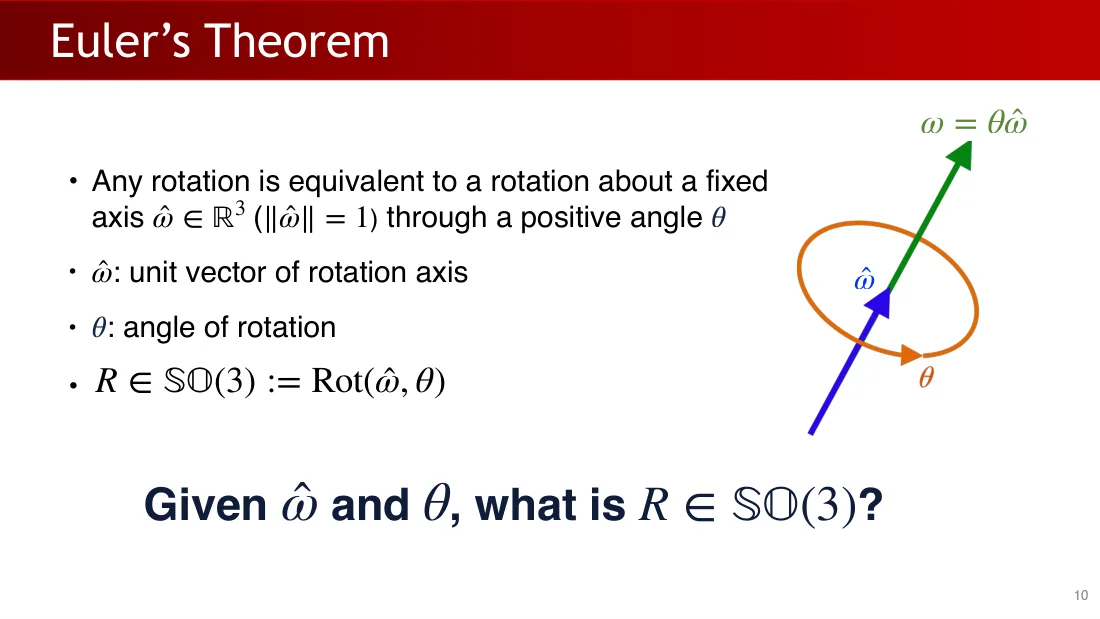
- 任意旋转都等价于绕一条固定轴 \(\hat{\omega } \in \mathbb{R}^{3}\)(\(\lVert \hat{\omega }\rVert = 1\))转过正角度 \(\theta\)。
- \(\hat{\omega }\):旋转轴的单位向量。
- \(\theta\):旋转角度。
- \[R \in \mathrm{SO}(3) := \operatorname{Rot}(\hat{\omega }, \theta )\]
图中:\(\omega = \theta \hat{\omega }\)。
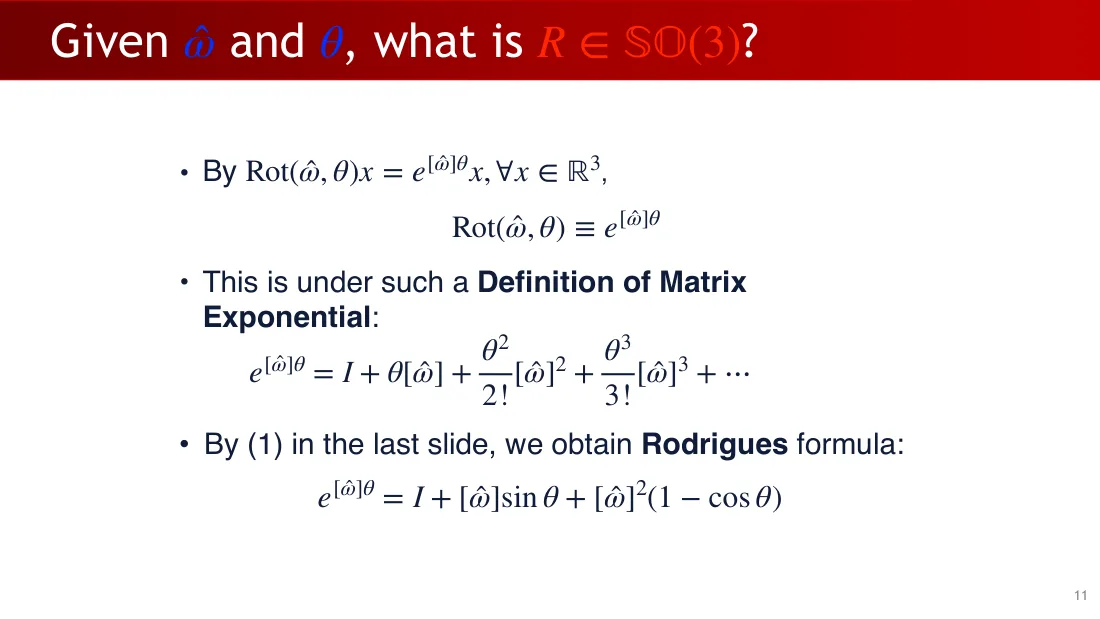
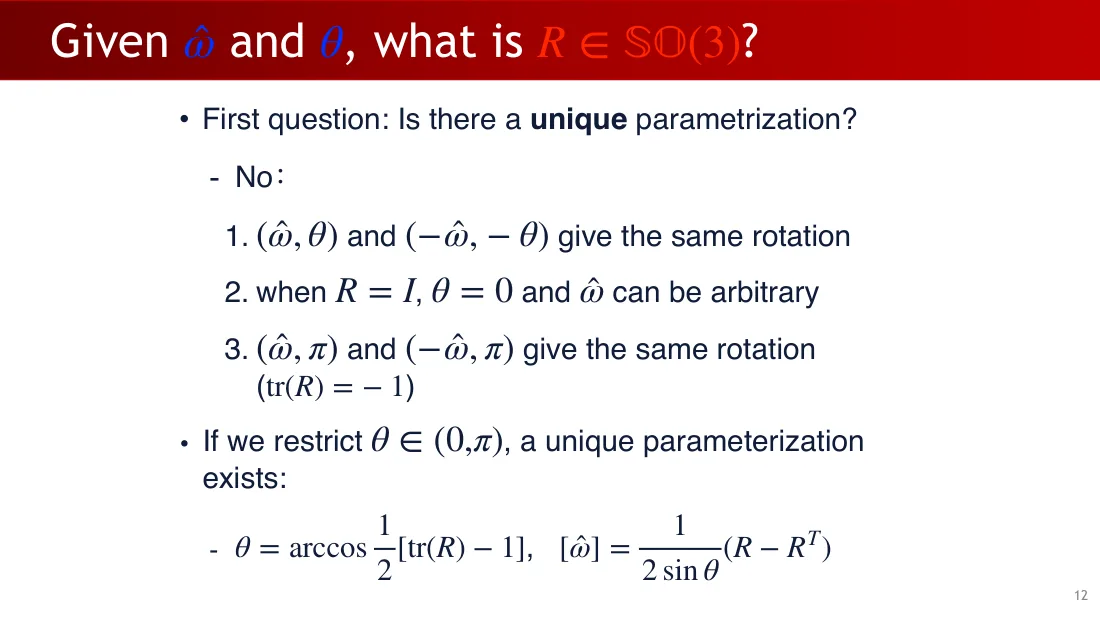
给定 \(\hat{\omega }\) 和 \(\theta\text{,}R \in \mathrm{SO}(3)\) 是什么?
Lecture 03 · PDF p11

- 由 \(\operatorname{Rot}(\hat{\omega }, \theta )x = \exp(\theta [\hat{\omega }]) x\),对所有 \(x \in \mathbb{R}^{3}\),得 \(\operatorname{Rot}(\hat{\omega }, \theta ) \equiv \exp(\theta [\hat{\omega }])\)。
- 这里采用如下矩阵指数定义:
\[\exp(\theta [\hat{\omega }]) = I + \theta [\hat{\omega }] + (\frac{\theta ^{2}}{2!})[\hat{\omega }]^{2} + (\frac{\theta ^{3}}{3!})[\hat{\omega }]^{3} + \cdots\]
- 根据上一张幻灯片的式(1),得到 Rodrigues 公式:
\[\exp(\theta [\hat{\omega }]) = I + [\hat{\omega }]\sin \theta + [\hat{\omega }]^{2}(1 - \cos \theta )\]
Lecture 03 · PDF p12

- 第一个问题:存在唯一的参数化吗?
- 不存在:
1. \((\hat{\omega }, \theta )\) 与 \((-\hat{\omega }, -\theta )\) 给出相同的旋转。
2. 当 \(R = I\) 时,\(\theta = 0\text{,}\hat{\omega }\) 可以任取。
3. \((\hat{\omega }, \pi )\) 与 \((-\hat{\omega }, \pi )\) 给出相同的旋转(\(\operatorname{tr}(R) = -1\))。
- 如果限定 \(\theta \in (0, \pi )\),则存在唯一的参数化:
- \[\theta = \arccos(\frac{\operatorname{tr}(R)-1}{2})\text{,}[\hat{\omega }] = \frac{R-R^{T}}{2\sin \theta }\]
Lecture 03 · PDF p13
Lecture 03 · PDF p14
Lecture 03 · PDF p15
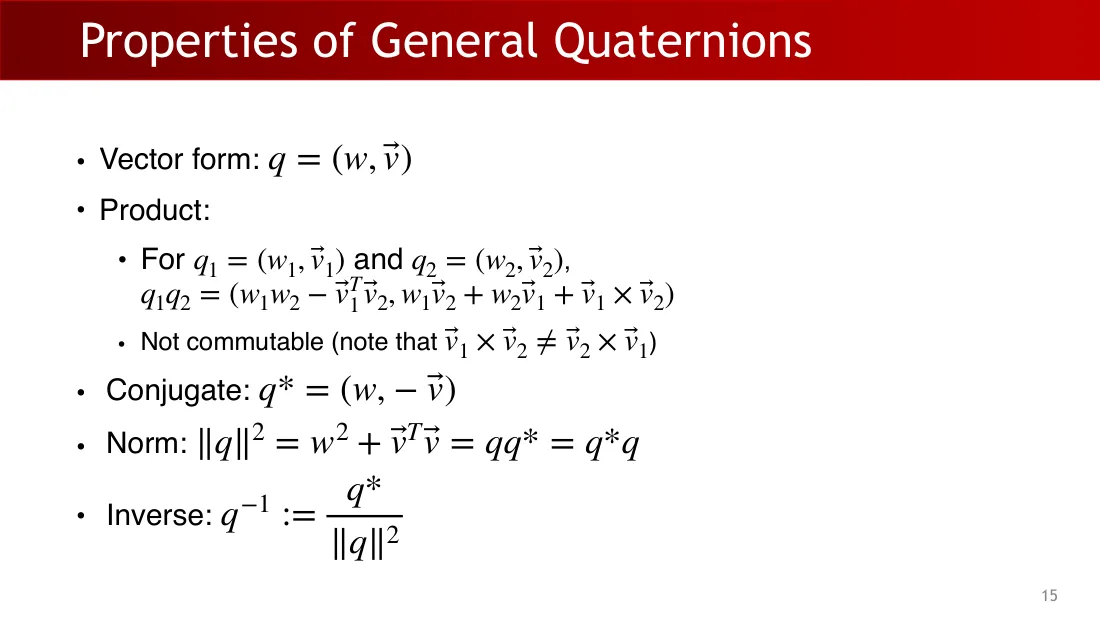
- 向量形式:\(q = (w, \vec{v})\)。
- 乘积:
- 对 \(q_{1} = (w_{1}, \vec{v}_{1})\)、\(q_{2} = (w_{2}, \vec{v}_{2})\text{,}q_{1}q_{2} = (w_{1}w_{2} - \vec{v}_{1}^{T}\vec{v}_{2}\text{,}w_{1}\vec{v}_{2} + w_{2}\vec{v}_{1} + \vec{v}_{1} \times \vec{v}_{2})\)。
- 不可交换(注意 \(\vec{v}_{1} \times \vec{v}_{2} \ne \vec{v}_{2} \times \vec{v}_{1}\))。
- 共轭:\(q^* = (w, -\vec{v})\)。
- 范数:\(\lVert q\rVert ^{2} = w^{2} + \vec{v}^{T}\vec{v} = qq^* = q^*q\)。
- 逆:\(q^{-1} := \frac{q^*}{\lVert q\rVert^{2}}\)。
Lecture 03 · PDF p16
Lecture 03 · PDF p17
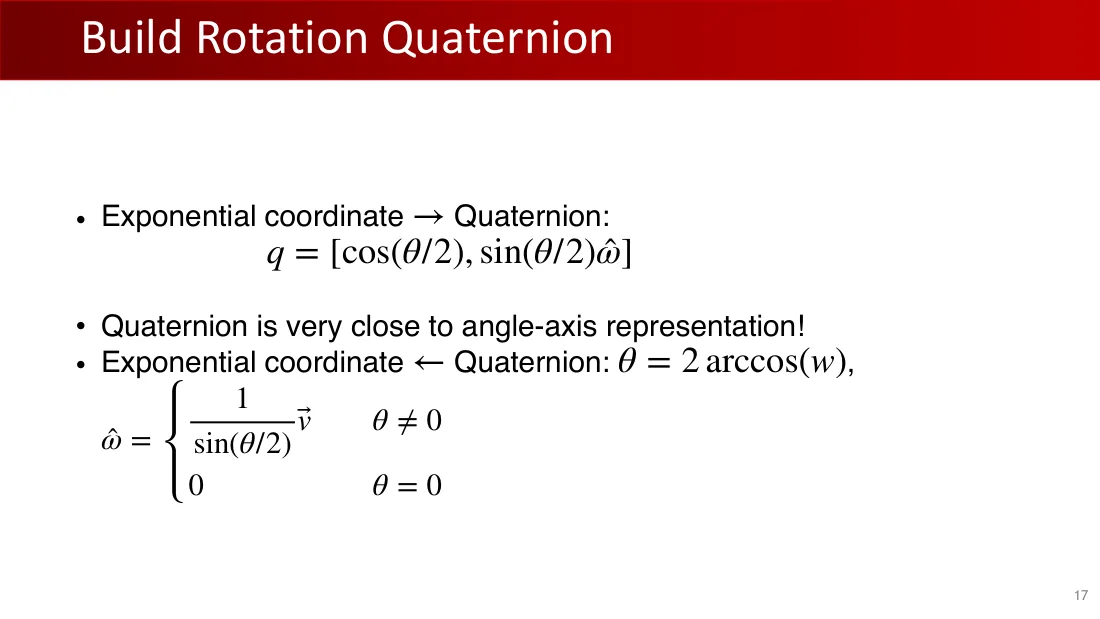
Lecture 03 · PDF p18
Lecture 03 · PDF p19
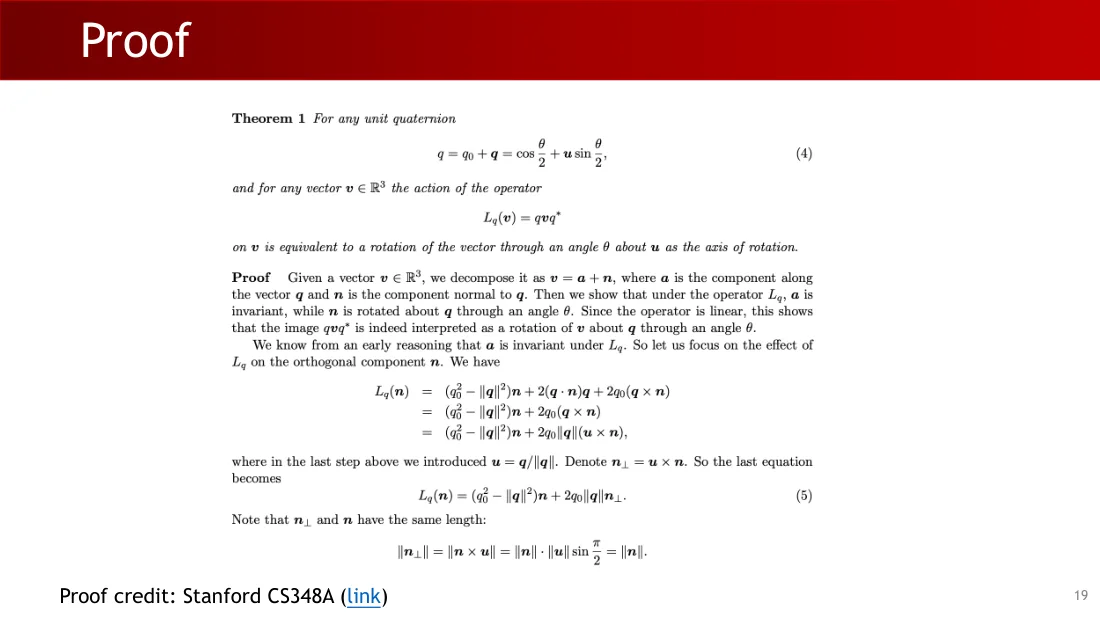
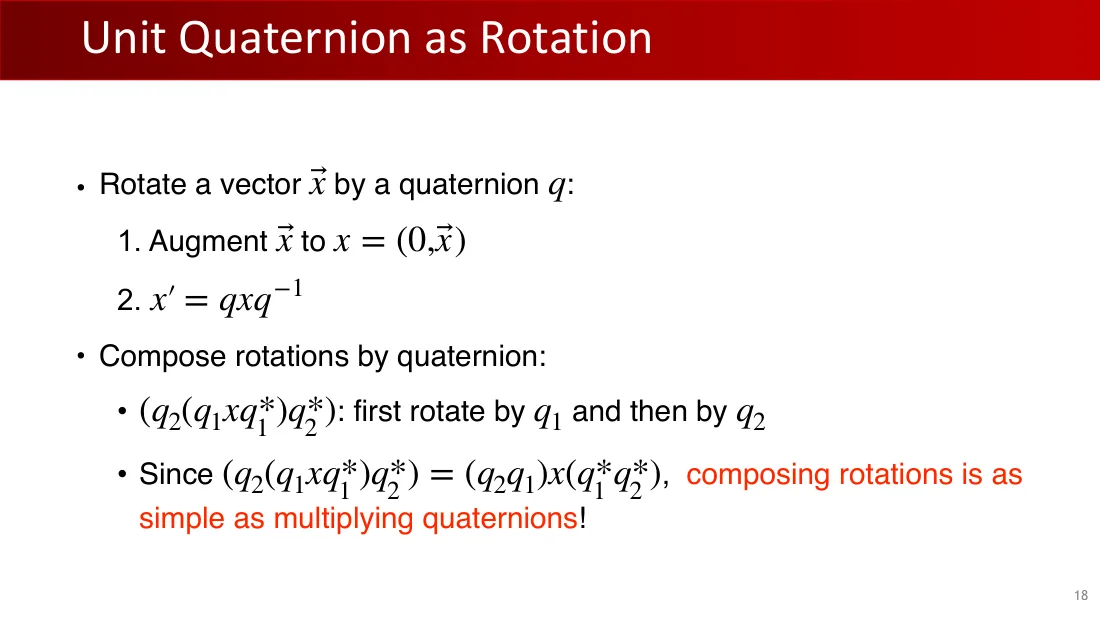
定理1:对于任意单位四元数 \(q = q_{0} + \vec{q} = \cos(\frac{\theta}{2}) + u \sin(\frac{\theta}{2})\)(4),以及任意向量 \(v \in \mathbb{R}^{3}\),算子 \(L_q(v) = qvq^*\) 作用于 v,等价于以 u 为旋转轴将该向量旋转 \(\theta\) 角。
证明:给定向量 \(v \in \mathbb{R}^{3}\),将其分解为 \(v = a + n\),其中 a 是沿向量 \(\vec{q}\) 的分量,n 是垂直于 \(\vec{q}\) 的分量。接着说明在算子 \(L_q\) 的作用下,a 保持不变,n 绕 \(\vec{q}\) 旋转 \(\theta\) 角。因为该算子是线性的,这就说明像 \(qvq^*\) 确实可以解释为 v 绕 \(\vec{q}\) 旋转 \(\theta\) 角。
根据前面的推理,a 在 \(L_q\) 下保持不变。因此,关注 \(L_q\) 对正交分量 n 的作用。我们有:
\[L_q(n) = (q_{0}^{2} - \lVert \vec{q}\rVert ^{2})n + 2(\vec{q}\cdot n)\vec{q} + 2q_{0}(\vec{q} \times n)\]
\[= (q_{0}^{2} - \lVert \vec{q}\rVert ^{2})n + 2q_{0}(\vec{q} \times n)\]
\[= (q_{0}^{2} - \lVert \vec{q}\rVert ^{2})n + 2q_{0}\lVert \vec{q}\rVert (u \times n)\]
上面最后一步引入了 \(u = \frac{\vec{q}}{\lVert \vec{q}\rVert}\)。记 \(n_{\perp} = u \times n\),于是最后一个等式变为:
\[L_q(n) = (q_{0}^{2} - \lVert \vec{q}\rVert ^{2})n + 2q_{0}\lVert \vec{q}\rVert n_{\perp}\]。(5)
注意 \(n_{\perp}\) 和 n 长度相同:\(\lVert n_{\perp}\rVert = \lVert n \times u\rVert = \lVert n\rVert \cdot \lVert u\rVert \sin(\frac{\pi}{2}) = \lVert n\rVert\)。
证明来源:斯坦福大学 CS348A(链接)。
Lecture 03 · PDF p20

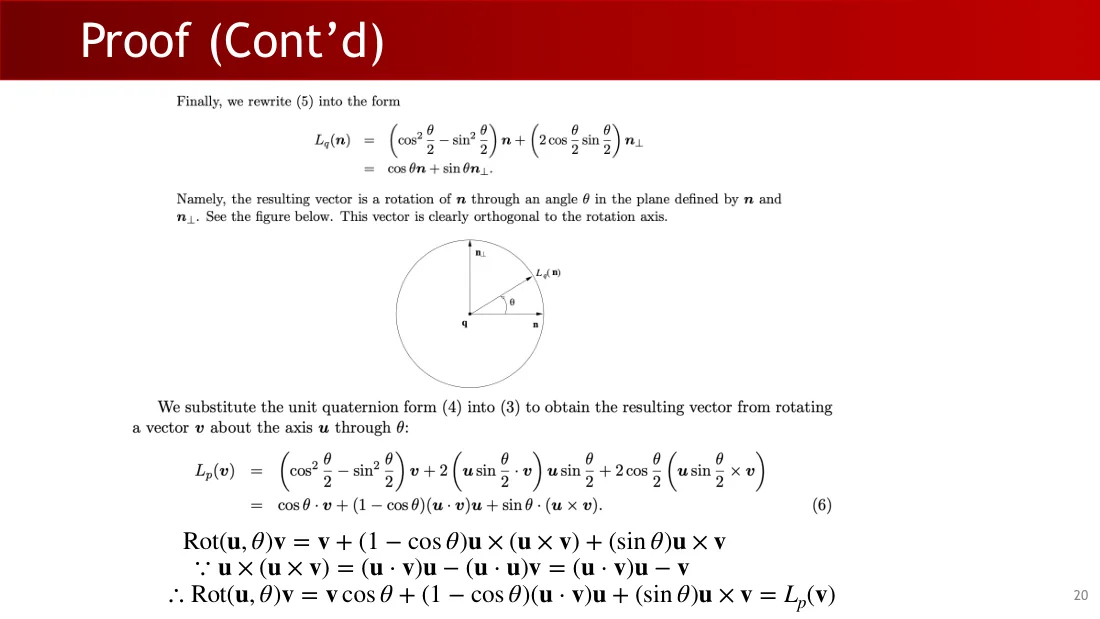
最后,将式(5)改写为:
\[L_q(n) = (\cos^{2}(\frac{\theta}{2}) - \sin^{2}(\frac{\theta}{2}))n + (2 \cos(\frac{\theta}{2}) \sin(\frac{\theta}{2}))n_{\perp}\]
\[= \cos \theta n + \sin \theta n_{\perp}\]
也就是说,得到的向量是 n 在由 n 与 \(n_{\perp}\) 定义的平面内旋转 \(\theta\) 角的结果。见下图。该向量显然与旋转轴正交。
将单位四元数形式(4)代入式(3),得到向量 v 绕轴 u 旋转 \(\theta\) 后的向量:
\[L_p(v) = (\cos^{2}(\frac{\theta}{2}) - \sin^{2}(\frac{\theta}{2}))v + 2(u \sin(\frac{\theta}{2})\cdot v)u \sin(\frac{\theta}{2}) + 2 \cos(\frac{\theta}{2})(u \sin(\frac{\theta}{2}) \times v)\]
\[= \cos \theta \cdot v + (1 - \cos \theta )(u\cdot v)u + \sin \theta \cdot (u \times v)\]。(6)
\[\operatorname{Rot}(u, \theta )v = v + (1 - \cos \theta )u \times (u \times v) + (\sin \theta )u \times v\]
因为 \(u \times (u \times v) = (u\cdot v)u - (u\cdot u)v = (u\cdot v)u - v\),
所以 \(\operatorname{Rot}(u, \theta )v = v \cos \theta + (1 - \cos \theta )(u\cdot v)u + (\sin \theta )u \times v = L_p(v)\)。
Lecture 03 · PDF p21
Lecture 03 · PDF p22
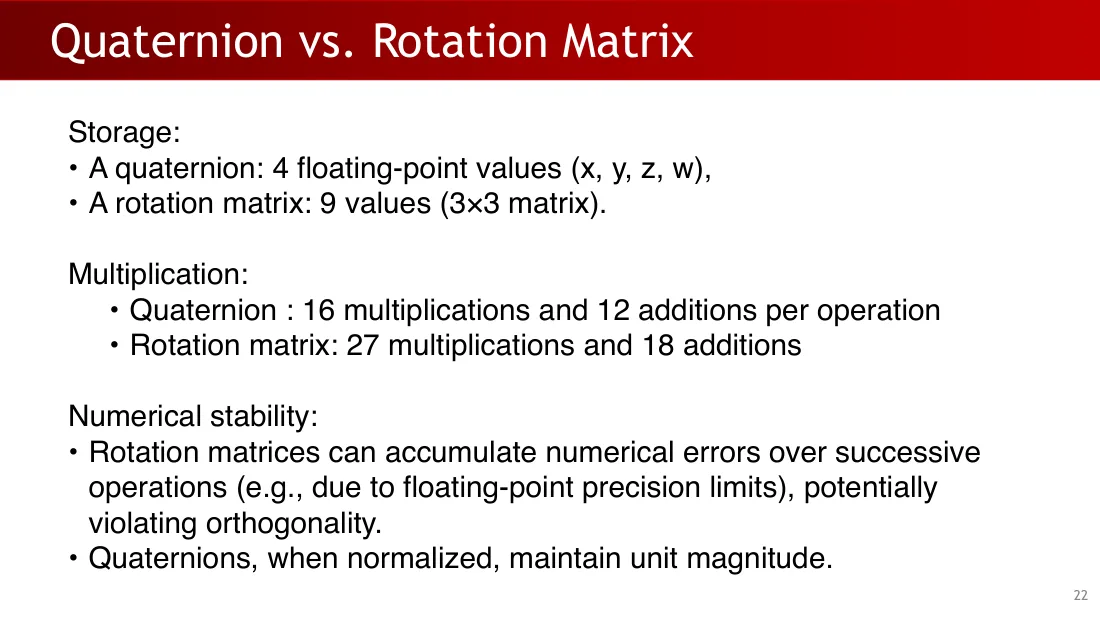
Lecture 03 · PDF p23
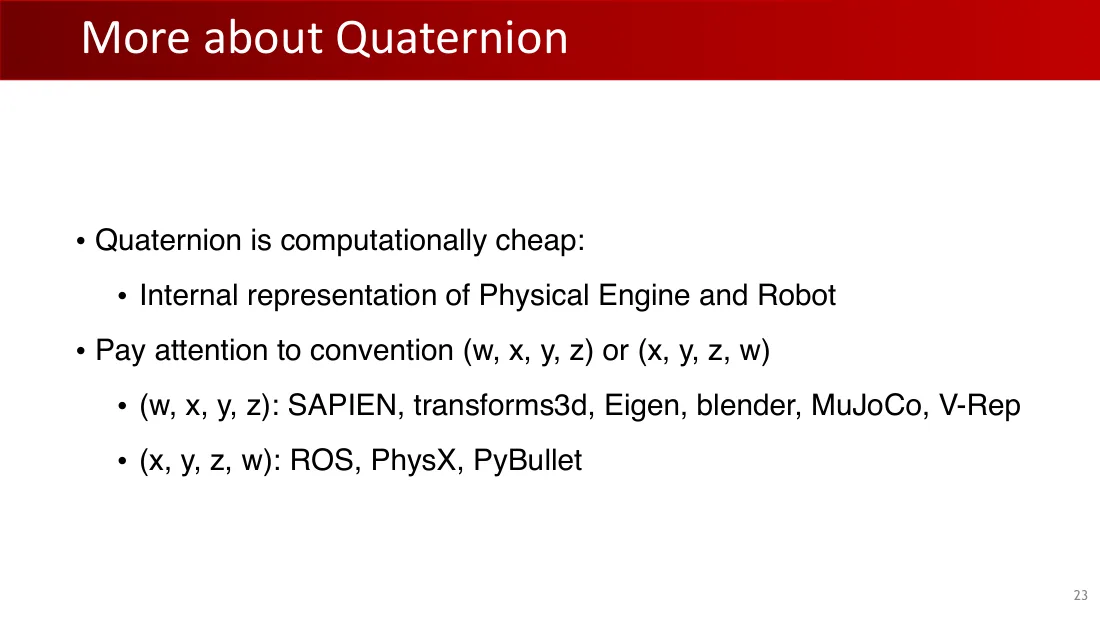
Lecture 03 · PDF p24
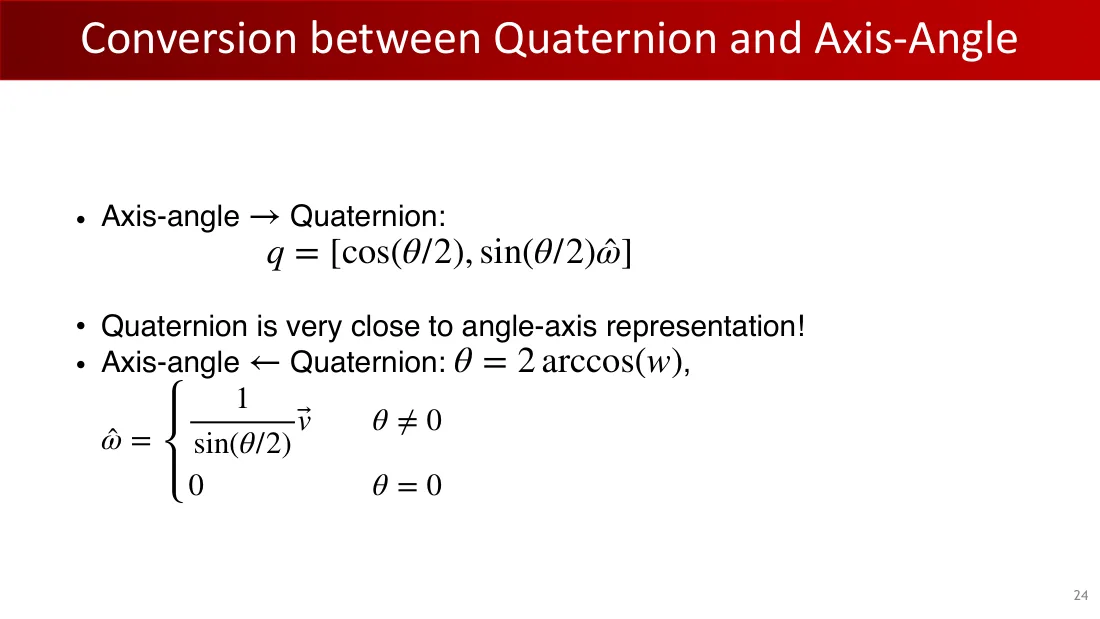
Lecture 03 · PDF p25
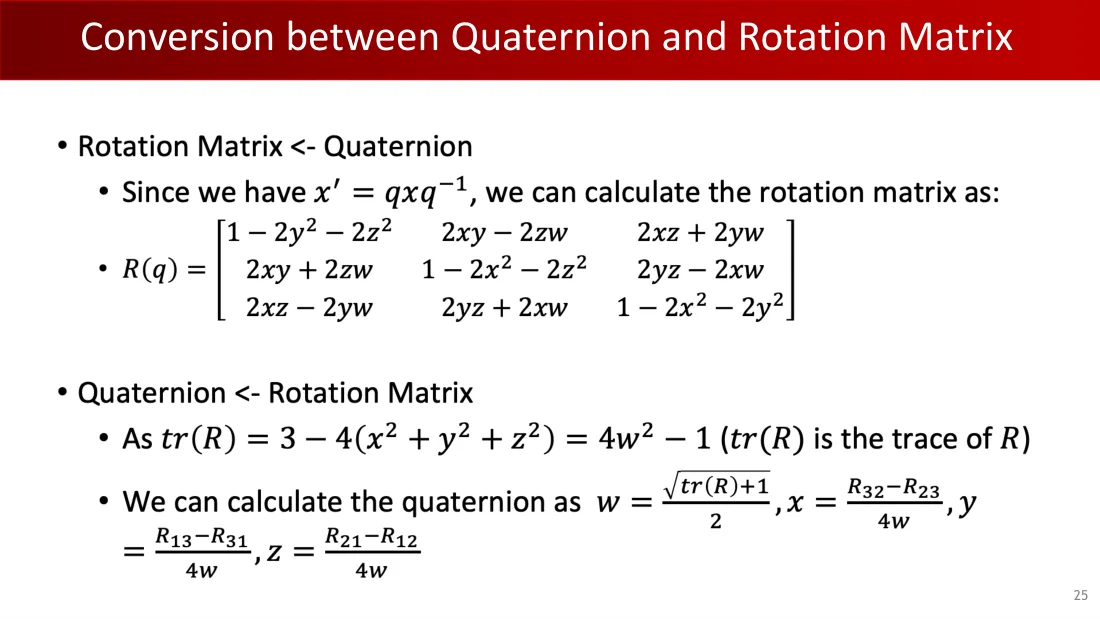
- 旋转矩阵 ← 四元数。
- 由 \(x' = qxq^{-1}\),可以算出旋转矩阵:
- \[R(q) = \begin{bmatrix}1-2y^{2}-2z^{2} & 2xy-2zw & 2xz+2yw \\ 2xy+2zw & 1-2x^{2}-2z^{2} & 2yz-2xw \\ 2xz-2yw & 2yz+2xw & 1-2x^{2}-2y^{2}\end{bmatrix}\]
- 四元数 ← 旋转矩阵。
- 因为 \(\operatorname{tr}(R) = 3 - 4(x^{2}+y^{2}+z^{2}) = 4w^{2} - 1\)(\(\operatorname{tr}(R)\) 是 R 的迹)。
- 可以计算四元数:\(w = \frac{\sqrt{\operatorname{tr}(R)+1}}{2}\text{,}x = \frac{R_{32}-R_{23}}{4w}\text{,}y = \frac{R_{13}-R_{31}}{4w}\text{,}z = \frac{R_{21}-R_{12}}{4w}\)。
Lecture 03 · PDF p26

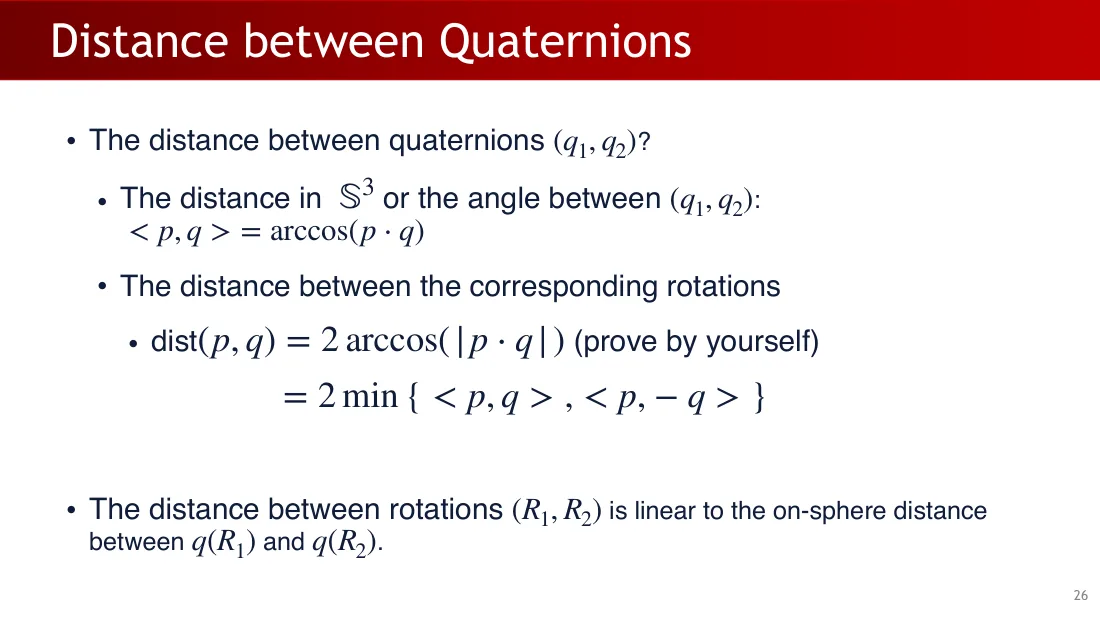
- 四元数 \((q_{1}, q_{2})\) 之间的距离?
- \[S^{3}\) 中的距离,或者 \((q_{1}, q_{2})\) 之间的夹角:\(\langle p, q\rangle = \arccos(p\cdot q)\]
- 相应旋转之间的距离:
- \[\operatorname{dist}(p, q) = 2 \arccos(|p\cdot q|)\)(请自行证明)\(= 2 \min\{\langle p, q\rangle , \langle p, -q\rangle \}\]
- 旋转 \((R_{1}, R_{2})\) 之间的距离与 \(q(R_{1})\)、\(q(R_{2})\) 之间的球面距离成线性关系。
Lecture 03 · PDF p27
Lecture 03 · PDF p28
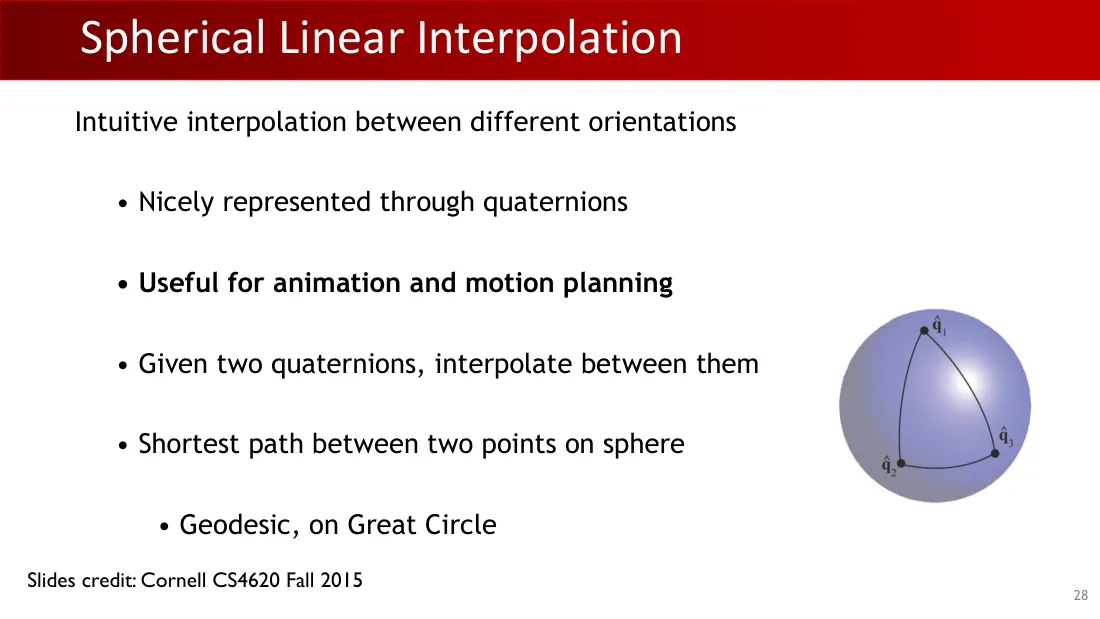
Lecture 03 · PDF p29
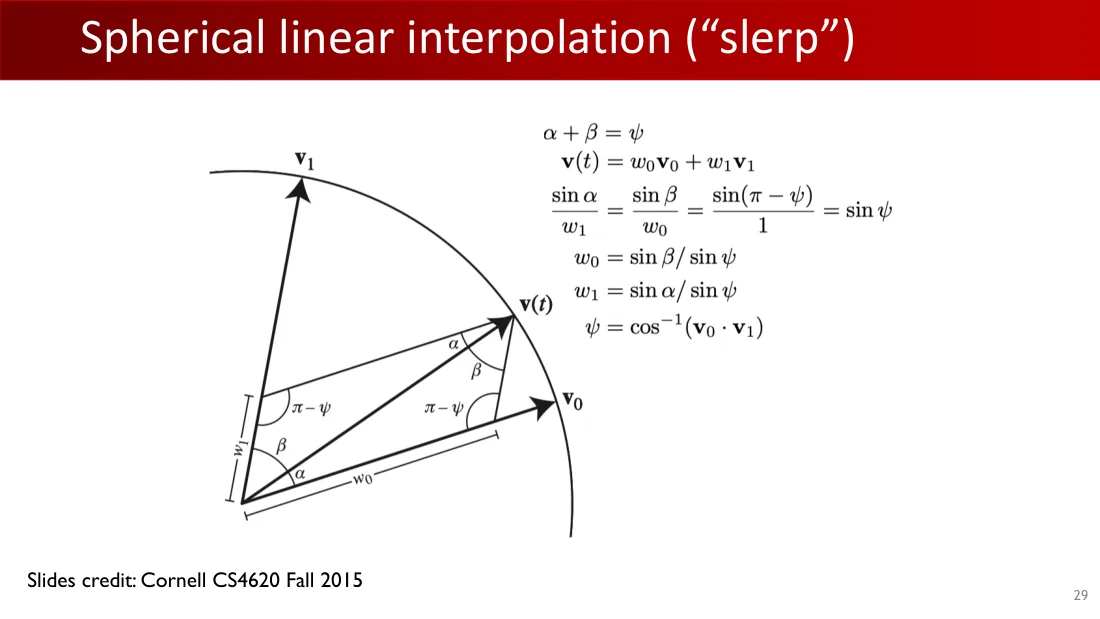
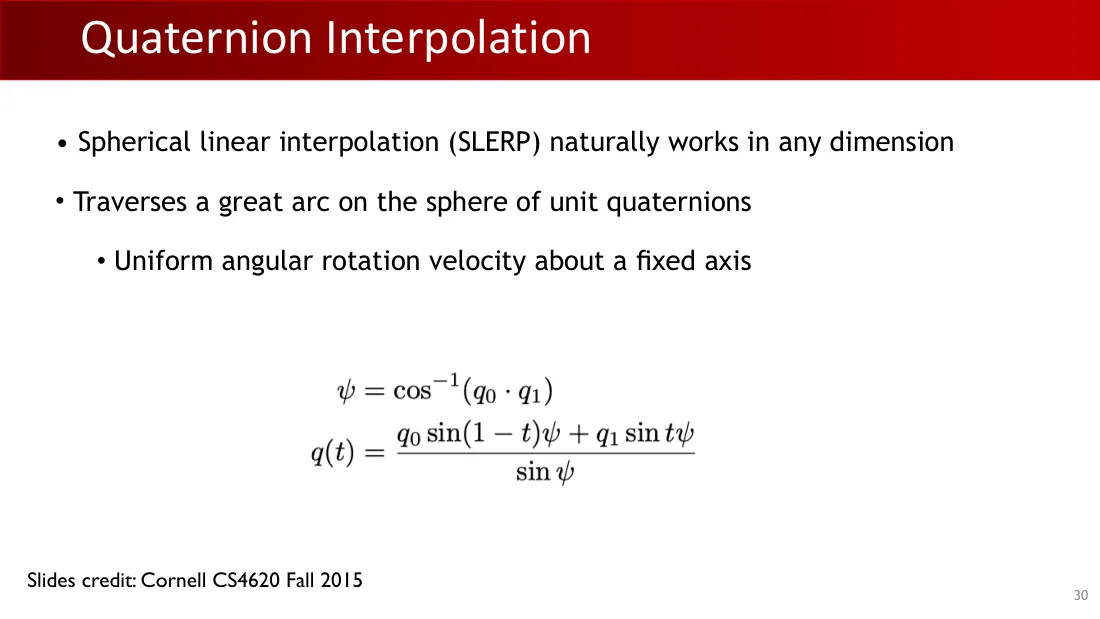
\[\alpha + \beta = \psi\]
\[v(t) = w_{0}v_{0} + w_{1}v_{1}\]
\[\frac{\sin \alpha }{w_{1}} = \frac{\sin \beta }{w_{0}} = \frac{\sin(\pi -\psi )}{1} = \sin \psi\]
\[w_{0} = \frac{\sin \beta }{\sin \psi }\text{;}w_{1} = \frac{\sin \alpha }{\sin \psi }\text{;}\psi = \cos^{-1}(v_{0}\cdot v_{1})\]
图中标记:\(v_{0}\)、\(v_{1}\)、v(t)、\(w_{0}\)、\(w_{1}\)、\(\alpha\)、\(\beta\)、\(\pi -\psi\)。
幻灯片来源:康奈尔大学 CS4620,2015年秋季。
Lecture 03 · PDF p30
Lecture 03 · PDF p31
Lecture 03 · PDF p32
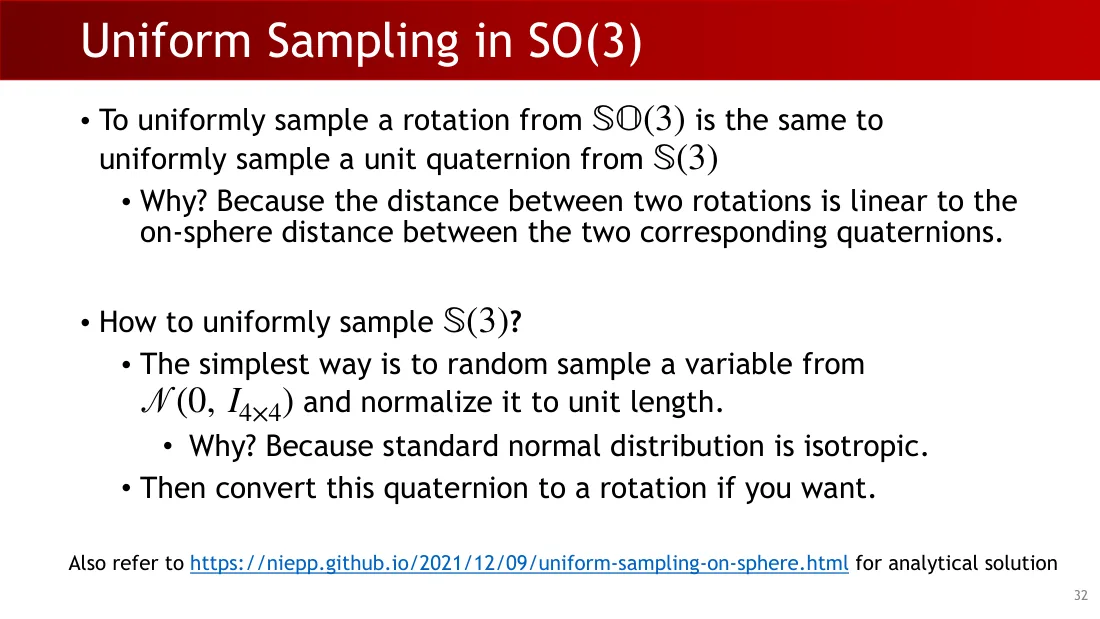
- 从 \(\mathrm{SO}(3)\) 中均匀采样一个旋转,等价于从 \(S(3)\) 中均匀采样一个单位四元数。
- 为什么?因为两个旋转之间的距离与相应两个四元数的球面距离成线性关系。
- 如何均匀采样 \(S(3)\)?
- 最简单的方法是从 \(N(0, I_{4\times 4})\) 中随机采样一个变量,然后将其归一化为单位长度。
- 为什么?因为标准正态分布具有各向同性。
- 如果需要,再将这个四元数转换为旋转。
- 最简单的方法是从 \(N(0, I_{4\times 4})\) 中随机采样一个变量,然后将其归一化为单位长度。
解析解还可参考:https://niepp.github.io/2021/12/09/uniform-sampling-on-sphere.html 。
Lecture 03 · PDF p33
Lecture 03 · PDF p34
Lecture 03 · PDF p35
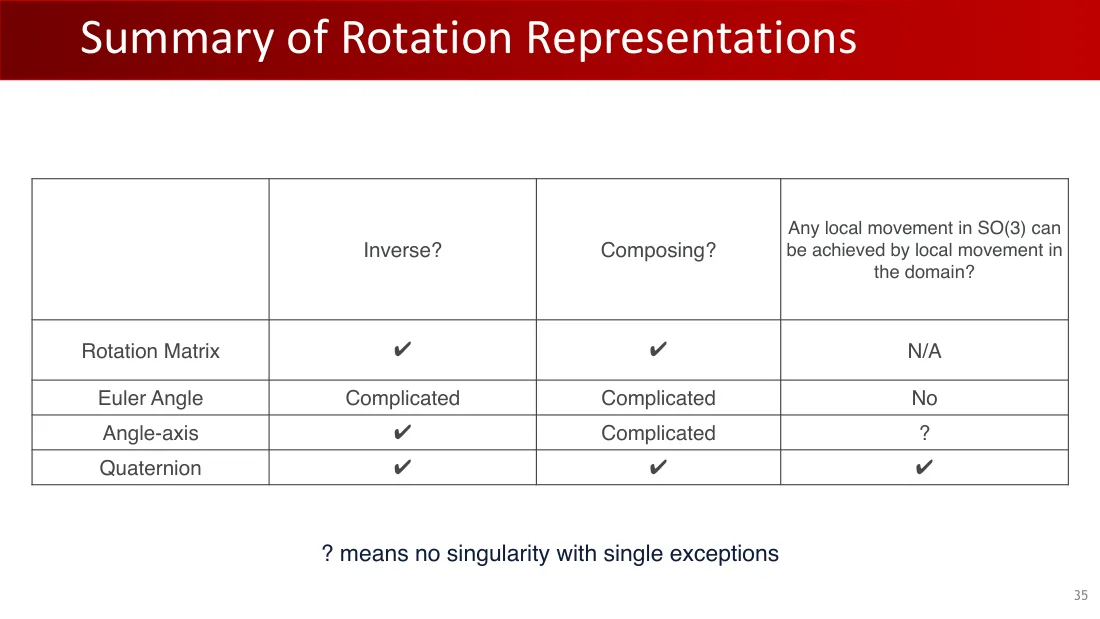
Lecture 03 · PDF p36
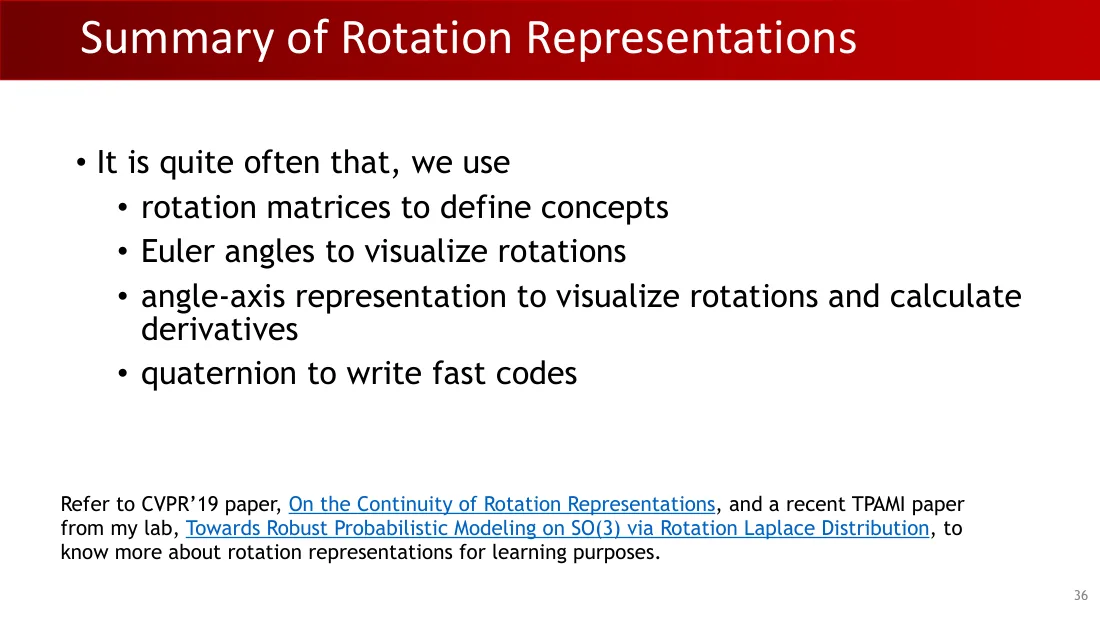
- 我们经常使用:
- 旋转矩阵来定义概念。
- 欧拉角来直观表示旋转。
- 轴角表示来直观表示旋转并计算导数。
- 四元数来编写运行速度快的代码。
若要进一步了解学习任务中的旋转表示,可参考 CVPR 2019 论文《旋转表示的连续性》(On the Continuity of Rotation Representations),以及本实验室近期的 TPAMI 论文《通过旋转拉普拉斯分布实现 \(\mathrm{SO}(3)\) 上的稳健概率建模》(\(Towards Robust Probabilistic Modeling on \mathrm{SO}(3) via Rotation Laplace Distribution\))。
Lecture 03 · PDF p37
Lecture 03 · PDF p38
Lecture 03 · PDF p39
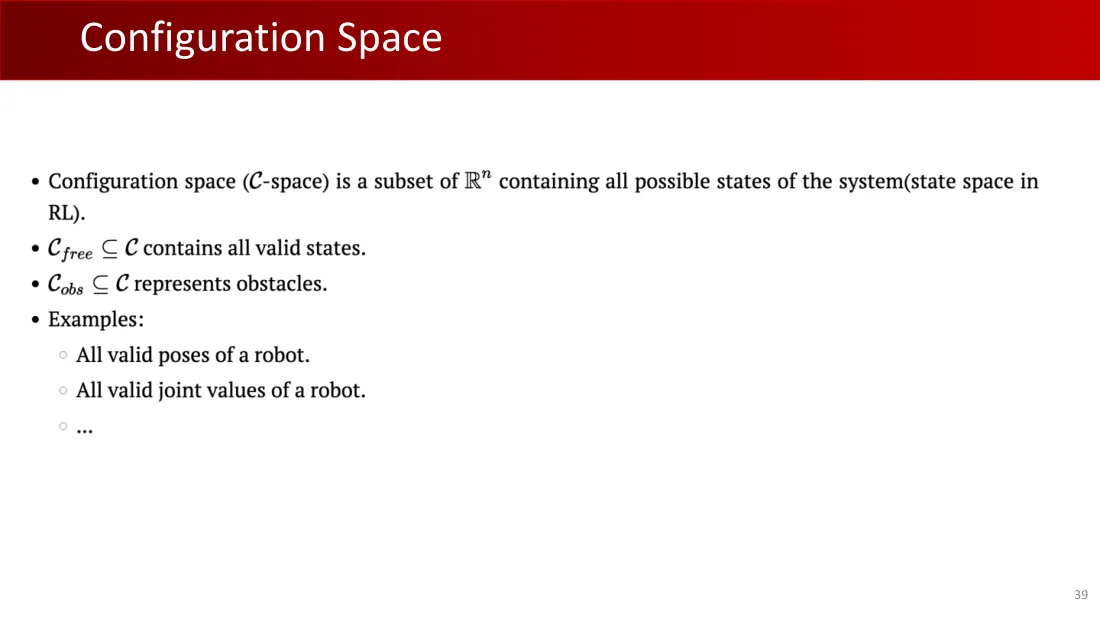
Lecture 03 · PDF p40
Lecture 03 · PDF p41
Lecture 03 · PDF p42
Lecture 03 · PDF p43
Lecture 03 · PDF p44